279
goals
2
scoring engines
98
automated tests
Transparency note. This work was carried out on a personal basis, for learning purposes, with the help of an AI:
- for the code and the technical and methodological review;
- to understand the tools and the mathematical methods;
- for help with writing, translating and correcting the text;
- to generate the cover image of this page.
The choice of topic, the protocol, the checking of the results and the conclusions are mine, and so are any mistakes. How I use AI
The problem#
Official preparedness guides (government, Red Cross) say what to do: a water supply, a first-aid kit, a go-bag, contacts on paper. They do not say where my household stands, or what has stopped being true since: the bottles that expire, the power bank never recharged, the first-aid course from three years ago, the baby who has arrived in the meantime.
I wanted a tool that:
- measures preparedness with checkable criteria (“14 days of water for this household”), not with a feeling;
- regresses when reality changes: an expired supply no longer counts, a skill not practised expires;
- fits the household: a 6th-floor flat does not have the same priorities as an isolated house, nor does a household with a child or a hard-to-refill prescription;
- works without a network, since the day the network is down is precisely the day it is needed;
- keeps the data at home: the household’s members, their health conditions and where their equipment is stored have no business on a third-party server.
Where the project stands#
v1 · The engine and the catalogue
2 November
A specification drawn from an interview
A specification written from an interview, then a YAML catalogue (levels, areas, goals, needs, questionnaire), a level engine in pure Python, a FastAPI API and a React interface with the column drawn in SVG.v2 · Offline on the phone
2 November
The engine ported to TypeScript
An installable app (PWA), an operation log in the browser, sync with the PC's server over Tailscale. The Python engine remains the reference; its TypeScript copy replays the same test cases.Four review councils
6 to 9 November
The catalogue tested against three viewpoints
At each council, three agents review the app and the catalogue, each from a different angle, then debate; I approve the plan before it is implemented. They brought the Crisis screen, the 30-day grace period, the Morale, Self-defence and Cybersecurity areas, physical fitness, and corrected content that was wrong or dangerous.Card inventory and skills
8 and 9 November
99 items, 117 talents
The inventory becomes a deck of cards with five grades each and a quantified overview; skills become nine talent trees.
What the app does#
A monument with nine tiers#
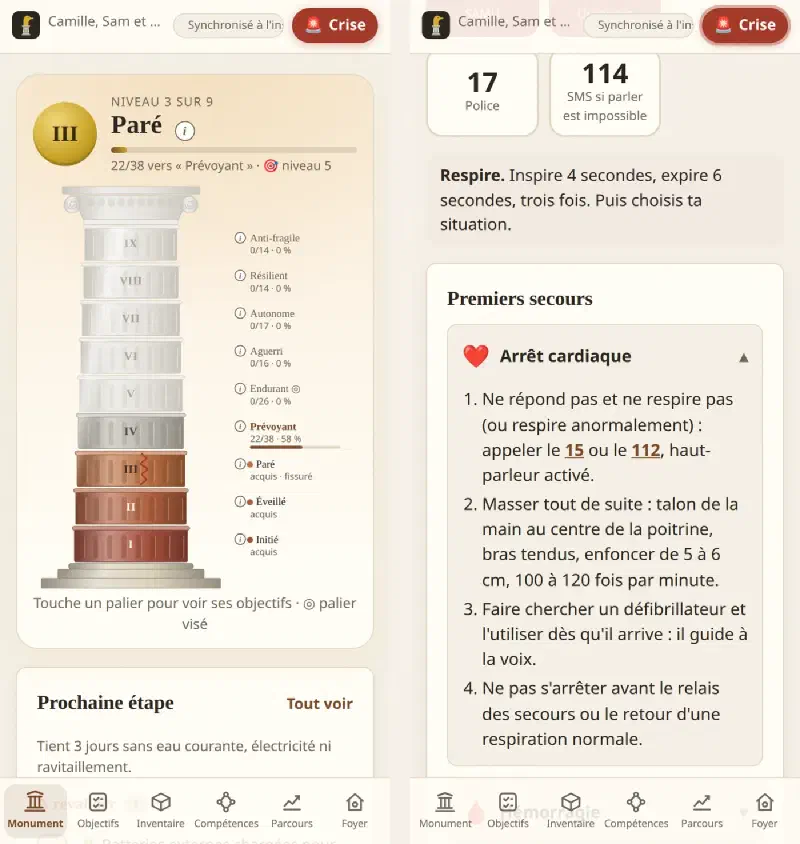
The household’s level is a monument with nine tiers, a Roman column by default. Each tier stands for a resilience horizon:
| Level | Name | What the household can withstand |
|---|---|---|
| 1 | Initiate | A few hours of outage: 24 h of water and food, a light, the emergency numbers |
| 2 | Aware | Knows its risks, has its papers, its contacts and a basic plan |
| 3 | Ready | 3 days without running water, electricity or resupply |
| 4 | Provident | 14 days confined or cut off from the grid |
| 5 | Enduring | 3 months of partial disruption, an emergency savings fund |
| 6 | Seasoned | 6 months of supplies, practical skills kept up |
| 7 | Self-reliant | Produces part of its own water, food and energy |
| 8 | Resilient | Part of a mutual-aid community, passes on what it knows |
| 9 | Antifragile | Everything is tested for real, each crisis improves the plan |
The tiers are blocking: level 4 is reached only once every required goal of levels 1 to 4 is validated, in every area. A household far ahead on water but with no evacuation plan stays at the tier of its weakest link, and the home screen says which one.
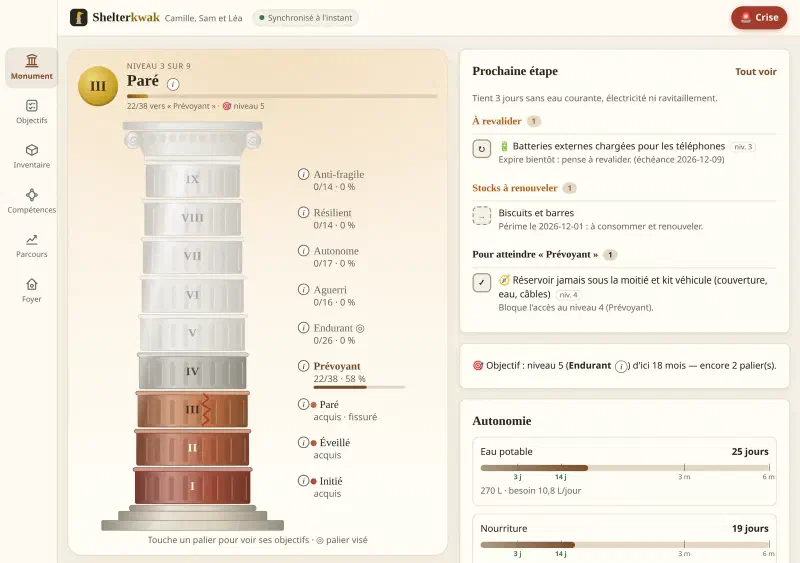
Level 9 cannot be bought: it requires testing the household (7 days without mains water, 72 hours with the main breaker off, a real evacuation in under 15 minutes, a surprise drill with one’s group), and almost all its criteria must be redone every year.
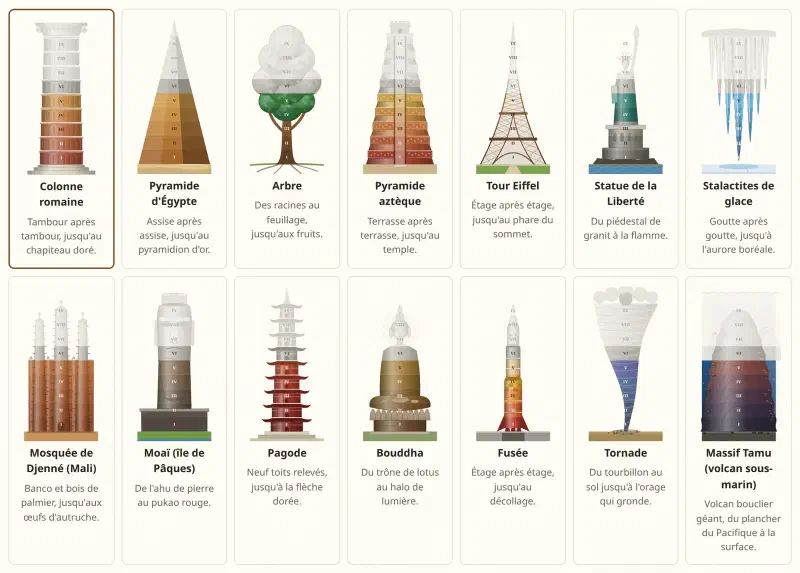
The monument is chosen from fourteen: a pyramid, a tree, the Eiffel Tower, the Great Mosque of Djenné, a moai, a rocket, an undersea volcano… Changing monument changes nothing about the level.
A level that can drop#
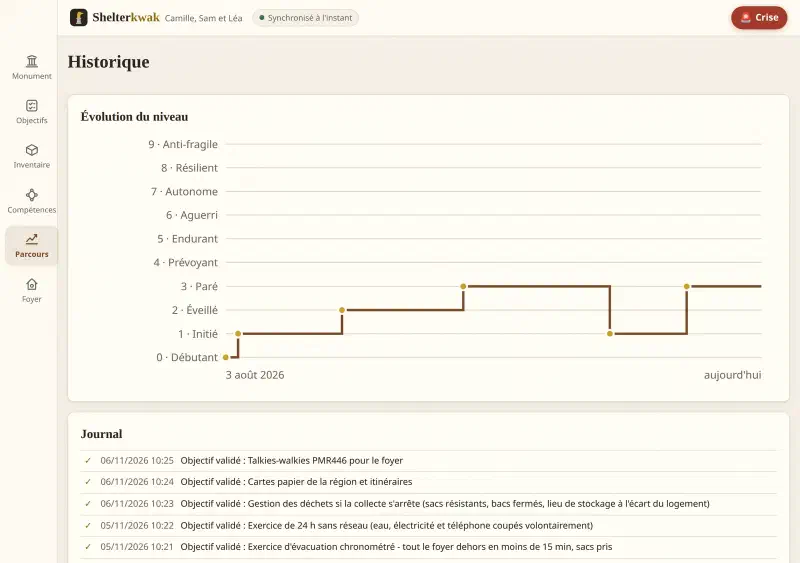
The level is not kept for good. It goes down when:
- a supply expires: an expired item immediately stops counting towards self-sufficiency;
- a validation expires: a skill to practise, a piece of equipment to test, a drill to repeat each have a period of validity;
- a seasonal deadline passes: firewood stored before November, the chimney swept before October;
- the household changes: one more member raises the needs and can make new goals apply.
So that a single forgotten power bank does not bring down several tiers at once, an expired validation first enters a 30-day grace period: the drum cracks but stays up. Expired supplies get no grace period. That compromise came out of the first council: a supply that is not renewed does not exist, but a sudden drop makes people give up on the tool.
279 goals that fit the household#
The goals are spread over 14 areas: water, food, energy, health, shelter, safety, communication, mobility, skills, finances, community, morale, self-defence and cybersecurity. Each has a level, an explanation (“why it matters”) and a kind: an action ticked by hand, a skill to revalidate, or a supply computed from the inventory.
A goal only shows up for the households it concerns:
- where they live: a flat does not need a campfire or fuel stored in the cellar, but must know how to use a camping stove without poisoning itself;
- the members: child, baby, senior, pet;
- health conditions: twelve in total, from glasses to a prescription that is dispensed in limited amounts. For glasses: a spare pair and a copy of the prescription at level 2, a pair in the go-bag at level 3, two spare pairs and a repair kit at level 5;
- declared risks: flooding, cold, heatwave, industrial hazard.
Physical tests (walking 15 km with a pack, being able to swim) have an adapted variant for households with a member who has reduced mobility: the requirement is about the household’s capability, not about each person’s fitness.
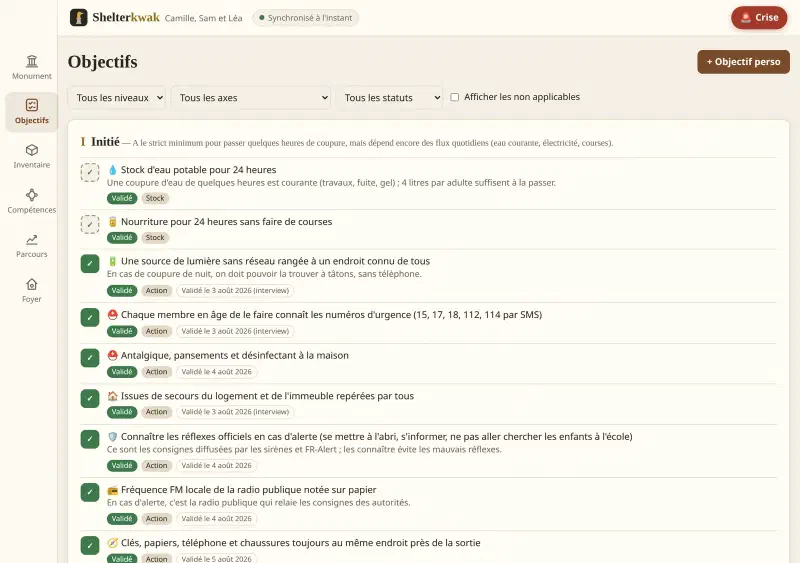
At sign-up, an adaptive questionnaire of 26 questions describes the household, where it lives now and where it plans to live (“a house in the countryside in two years”), what is already in place and the target level. The app infers a starting level from it. Goals specific to the planned home are offered separately, in a “Prepare for what’s next” section.
An inventory measured in days of self-sufficiency#
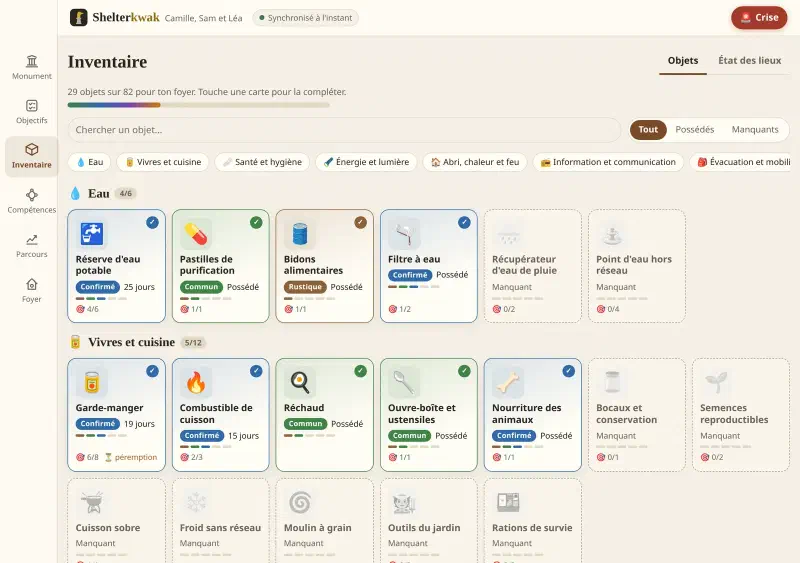
The inventory answers one question: how many days can the household hold out? Each item has a quantity, an expiry date and a storage place; self-sufficiency is the sum of unexpired items divided by the household’s daily need, computed member by member (4 L of water per adult, 2.5 L per child, 0.3 L for a cat; 2,200 kcal per adult).
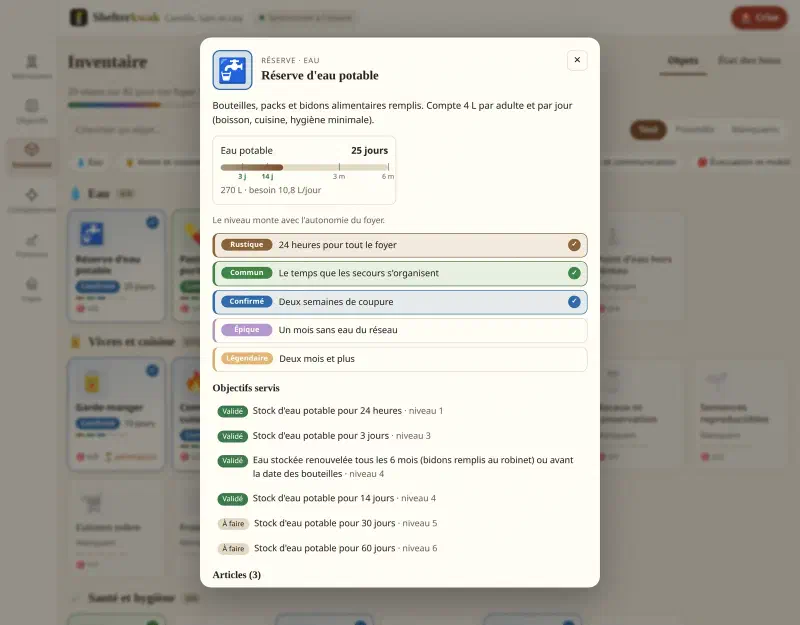
Equipment takes the form of 99 cards in ten categories, each with five grades (rustic, common, confirmed, epic, legendary). A card’s grade depends on its quality, its options, the quantity, the minimum contents (for a first-aid kit or a bag) or, for a supply, the days of self-sufficiency. A card shows which goals it serves, but owning an item validates nothing: it has to be confirmed.
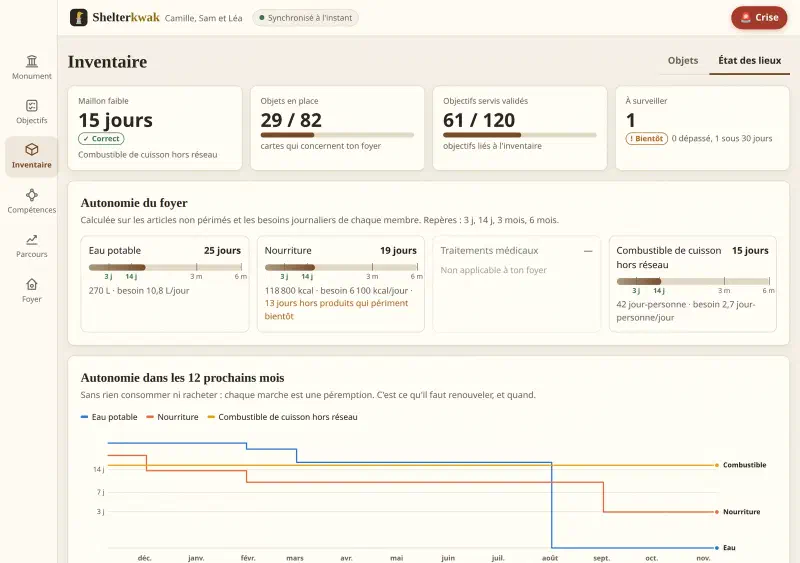
The overview sums up the inventory: the weakest link, self-sufficiency per category against the 3-day, 14-day, 3-month and 6-month marks, and a twelve-month projection showing when self-sufficiency drops as items expire, assuming nothing is consumed or bought.
Nine skill trees#
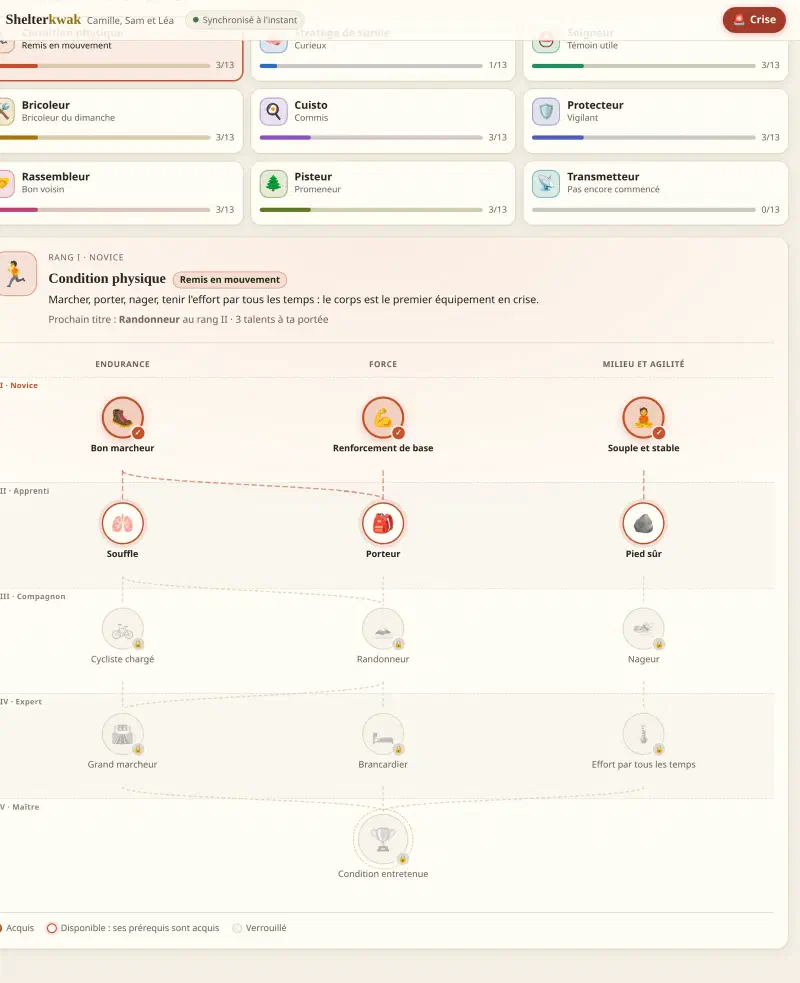
Skills are grouped into nine specialities (physical fitness, healer, handyman, cook, protector, gatherer…), each a talent tree with five ranks and three branches. A talent can be ticked once its prerequisites are acquired, with what proves it (a certificate, a test), a date and a note. As with items, ticking a talent validates no goal.
A screen for the day itself#
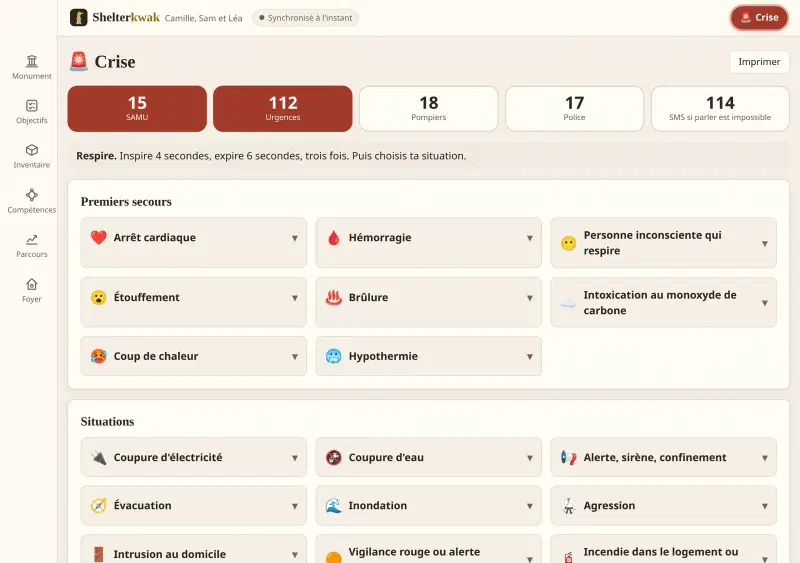
The red “Crise” button stays visible on every page. It opens a screen designed for someone under stress, which works offline and can be printed:
- call buttons (15, 112, 18, 17, and 114 by text message, the French emergency numbers) and a breathing reminder;
- folded reflex sheets: first aid (cardiac arrest, bleeding, carbon monoxide, heatstroke…) then situations (water cut, flood, evacuation, intrusion…), filtered by the household’s risks and members;
- the household’s own sheets: contacts, meeting points, who does what, medical sheets;
- where the equipment is, from the inventory, and the drinking-water supply.
On the phone, without a network#
The app installs on Android like a native app. The engine, the catalogue and the data live on the phone: in airplane mode, everything works. The PC’s server is used to install it, to sync the phone and the computer, and as a backup. It is reachable over Tailscale, in HTTPS, at home or away, with nothing exposed to the Internet.
How it is built#
An operation log rather than a state#
Nothing is stored as is: every change is an immutable operation (validate a goal, add an item, change the household), timestamped and identified. The household’s state, its level and its whole history are rebuilt by replaying the log in order.
flowchart LR
    T["Phone
PWA + IndexedDB"] -->|operations| S["PC server
FastAPI + SQLite"]
    P["PC browser
PWA + IndexedDB"] -->|operations| S
    S -->|other devices' operations| T
    S -->|other devices' operations| P
    T --> M1["TypeScript engine
replays the log"]
    S -.->|read only| M2["Python engine
the reference"]
That choice settles three problems at once:
- sync: each device sends the operations the server does not know and receives the others’. Two changes to the same thing are settled by timestamp: the last one written wins;
- history: the level curve is not recorded but recomputed, including on the dates when a supply expires or a grace period ends, the only moments the level changes without any action;
- rule changes: when a council moves a goal to another tier, the level is recomputed over the whole log, with no data migration. The one constraint: a goal’s identifier is never renamed, since it is stored.
The server computes nothing for the app: it keeps the shared copy of the log and serves the files. A JSON backup of the log can be exported from the Household tab.
Two engines, one behaviour#
To work offline, the level engine has to run on the phone, so in TypeScript. But the Python engine is easier to test and to review. Both exist, and Python is the reference: a script generates test cases from it (households, logs, dates), which the front-end tests replay to check that the TypeScript engine gives exactly the same result. A test fails if the cases were not regenerated after a catalogue change.
Content outside the code#
Goals, daily needs, the questionnaire, item cards, talents and Crisis sheets live in YAML files, not in the code. Adding a goal means adding an entry:
  - id: eau.exemple
    level: 4                 # tier
    kind: check              # check | skill | stock
    required: true           # false: bonus, does not block the tier
    contexts: [periurbain, rural]
    revalidate_days: 365     # expires and lowers the level
    title: …
    why: …
The catalogue is validated at start-up (references, levels, the order of an item’s grades), and a test checks that every type of home keeps at least one required goal per tier, so that no household reaches the top through empty tiers.
A catalogue reviewed in council#
The catalogue is the most delicate part: a misplaced criterion discourages, wrong content can be dangerous. I had it reviewed by a council of three AI agents, each with an angle: the Tracker (self-reliance in rural settings), the Tactician (urban crisis and logistics) and the Sentinel (health, vulnerable people, psychology). Each analyses alone, without knowing the others’ views; the main agent checks their findings in the code, leads the debate and writes a summary that I approve or not. Each council has its dated report in the repository.
A few corrections that came out of it:
| Finding | Decision |
|---|---|
| A campfire required in a flat | Fire and fuel kept for suburban and rural homes, a safe stove in town |
| Physical tests blocked a household with a member of reduced mobility for good | An adapted variant, the requirement stays for the others |
| Level 3 had 27 required criteria, several unrelated to “holding out 72 h” | Cut to 19, the rest moved to level 4 |
| A PSC1 first-aid course required at level 3, to be booked weeks ahead | “Gestes qui sauvent” (2 h, free) at level 3, PSC1 at level 4 |
| Supplies estimated at sign-up never expired | They expire after six months unless confirmed |
| Silver tablets given to purify water, an FFP2 mask against smoke | Chlorine or chlorine dioxide for water; FFP2 stops particles, not CO or gases |
What’s next#
The 9 November council is being implemented: showing the weapon, alcohol and tobacco cards only to households that declare them (they still show for everyone), removing duplicate cards that offer the same goal twice, and correcting some content. The next leads are revalidation reminders, a structured medical sheet per member, and a trial on a small home server. The end-to-end scenario (phone and PC, airplane mode, sync) is in the repository; it still has to run in continuous integration.
Try it#
git clone https://github.com/gwils28/Shelterkwak
cd Shelterkwak
make install   # Python (uv) and Node dependencies
make check     # lint, tests, engine parity, build
make run       # the app on http://127.0.0.1:8000
Installing on an Android phone, with Tailscale, is described in docs/telephone.md (in French).